
1win Plinko Indonesia: Rows, Risk and How the Ball Drops
The 1win Plinko game is a ball-drop title built by BGaming, with nothing to do with spinning reels or a rising multiplier. Plinko rules stay the same regardless of the row count or risk level chosen. A player picks a number of rows and a risk level before dropping a ball, and that ball bounces down a pegboard into one of several multiplier slots at the bottom. This page covers how a round works, how rows and risk settings are chosen, how those settings shape the general spread of outcomes, the free demo mode, and how Plinko handles on a mobile screen. For the wider catalog, the 1win-indonesia-game.id home page covers more than Plinko alone.
Last reviewed: August 2026.
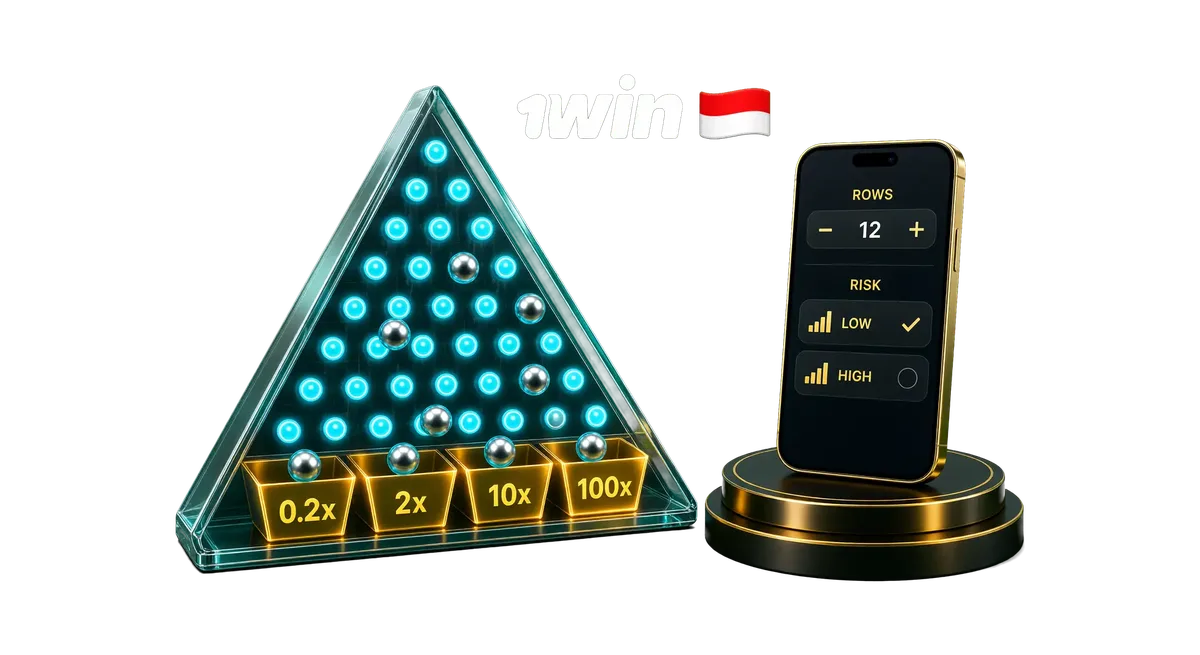
Key Takeaways
- Plinko is a ball-drop game: a chosen number of rows and a risk level are set before each drop, and the ball’s bounce path decides which multiplier slot it lands in.
- Higher risk settings widen the spread of outcomes; lower risk keeps outcomes closer together.
- A free demo mode is confirmed on Plinko, letting different row and risk combinations be tried on a virtual balance.
- An auto-play or auto-drop control may be available depending on the current interface, worth checking directly rather than assumed.
- No fixed payout table is stated here. Multiplier slot values are set inside the game and can vary by version.
How Plinko Works: Rows, Risk and the Ball Drop
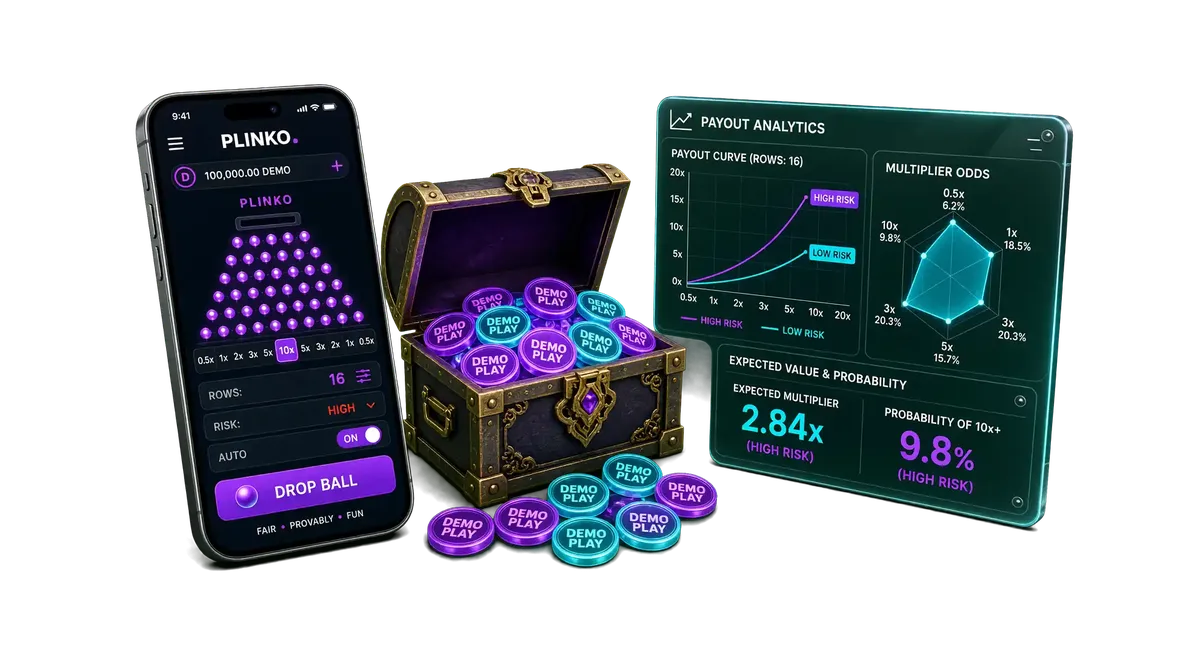
Plinko is developed by BGaming, and the mechanic is a drop rather than a spin. Before each round a stake is set, along with a number of rows for the pegboard and a risk level. Once a drop is triggered, a ball falls from the top and bounces off a series of pegs on the way down, with each bounce nudging it left or right in a way that cannot be predicted in advance. By the time the ball reaches the bottom, it lands in one of a row of multiplier slots, and that slot’s multiplier applies to the stake for that drop. Edge slots generally carry larger multipliers than middle slots, since a ball needs a long run of bounces in the same direction to reach an edge. Each drop is independent of the ones before it, so a run of central landings does not make an edge landing more or less likely on the next drop.
Rows and Risk: What to Choose Before You Drop
Two settings are chosen before a ball drops: the number of rows on the pegboard, and a risk level, usually offered as a small set of tiers such as low, medium and high. More rows generally means more bounce points between top and bottom, which changes the layout of the board, though the exact effect depends on the row count chosen. The risk setting works alongside the row count to shape how multiplier values are distributed across the slots at the bottom. Both settings can typically be changed between drops. Neither setting changes the physics of an individual bounce — they only change how the multiplier slots are arranged and valued.
How Risk and Rows Shape the Payout Spread
Risk level and row count together set the general shape of Plinko’s payout distribution rather than any single outcome. A higher risk setting tends to skew results toward a wider spread: a small number of slots carry noticeably larger multipliers, while more of the remaining slots sit at low or near-zero values. A lower risk setting keeps the multiplier range narrower, trading the chance at a large multiplier for outcomes that stay closer to the stake on average. No specific multiplier table is fixed here. The exact values assigned to each slot live inside the game itself and differ by version. The compare page has a side-by-side look at how Plinko’s spread compares with other games on this domain.
Auto-Play, If Enabled, and Manual Drops
Manual play means triggering each drop individually and deciding on the next stake, row count or risk level before the following drop. An auto-play or auto-drop control, where the game runs a set number of drops automatically at a fixed stake, is a common feature on similar ball-drop titles, removing the need to trigger every drop by hand if enabled in the current interface. Whether auto-play is present, and what settings it offers, can depend on the version running at the time, so checking the game’s own control panel is the reliable way to confirm it.
Plinko Demo: Trying It With Play Money
A free demo mode is confirmed for Plinko, running on a virtual balance instead of real funds. That makes it a practical way to try different row counts and risk levels, and to build a feel for how the bounce path and multiplier spread behave, before committing real money. Winnings generated during a demo session are not real and cannot be withdrawn, since the balance behind them is not real money.
Playing Plinko on Mobile in Indonesia
Plinko runs directly in a mobile browser without a separate install. The pegboard scales down to fit a phone screen while keeping the row selector, risk selector and drop button reachable with a thumb. Switching rows or risk level is usually a tap on a small selector menu rather than a slider needing precise dragging. A stable connection is worth having before a session starts, since a lag spike partway through a drop sequence, especially with auto-play running, could interrupt a run of automatic drops. The app page covers general mobile navigation beyond Plinko alone.
Provider Background and a Note on Randomness
Plinko on 1win is developed by BGaming, one of several studios behind the games covered on this domain. Every drop is generated independently, meaning the ball’s path on one drop has no connection to the drop before or after it. No row count, no risk setting and no drop timing changes that underlying randomness or makes a particular slot more likely to come up next.
FAQ
Does Plinko have a free demo mode?
Yes. A demo mode is confirmed, running on a virtual balance so different row and risk combinations can be tried without real funds.
Does a higher risk setting mean bigger wins?
It means a wider spread of outcomes. Larger multipliers become possible, but more low or near-zero results happen too.
Is auto-play always available in Plinko?
Not necessarily. Whether it is present depends on the current interface, worth checking rather than assuming.
Does the row count change the odds of winning?
It changes the layout of the multiplier slots rather than the fairness of each bounce. Each drop stays independent regardless of row count.
Can previous drops predict the next one?
No. Each drop is generated independently, so a run of similar landings does not make the next drop more or less likely.
Does Plinko work the same on mobile as on desktop?
Yes, in terms of what is available, just resized and made tap-friendly for a smaller screen.
1win operates under a Curaçao gaming license, a regulatory framework that is separate from any Indonesian government approval. 18+.