
1win Crash Games: Aviator, JetX and Lucky Jet
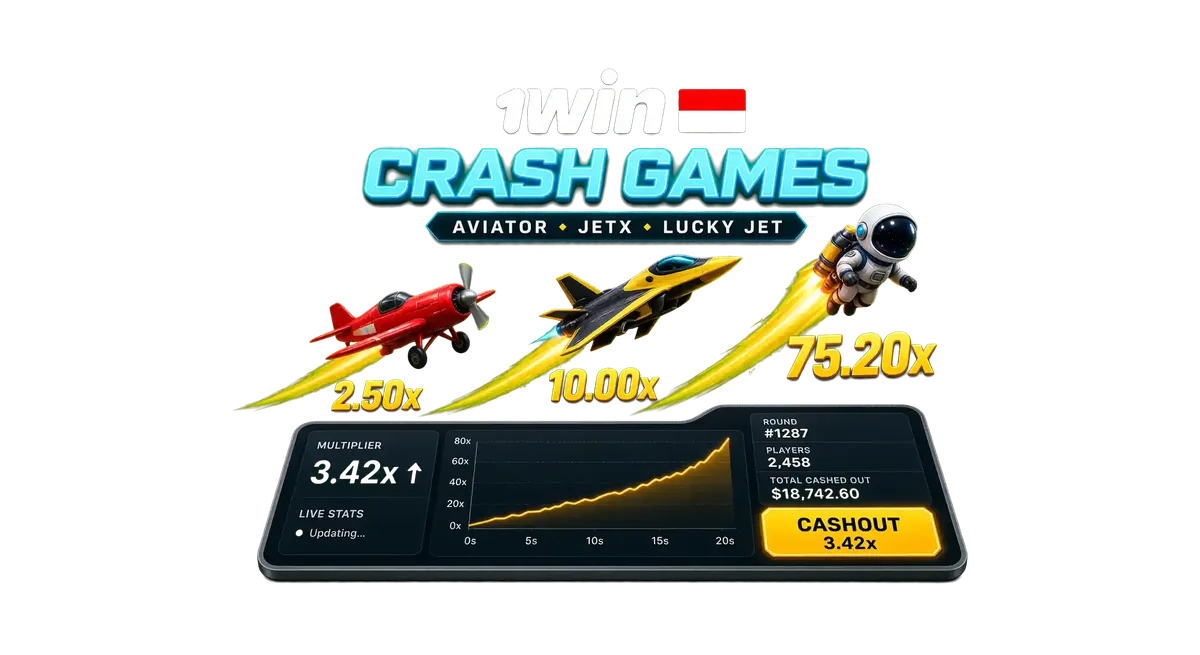
Crash games are one of the most recognizable categories in 1win’s catalog, built around a single repeating idea: a multiplier rises from the start of a round, and a player decides when to cash out before it stops. On 1win-indonesia-game.id, three titles fall into this category: Aviator, JetX and Lucky Jet. This page explains how the crash format works in general, the terminology used across these games, and how the three titles compare on the facts that are actually confirmed. Plinko, Mines and Avia Masters are not part of this comparison, since each uses a different core mechanic — Plinko is a ball-drop game, Mines is a grid-reveal game, and Avia Masters is a casual plane-style title with its own trajectory mechanic, not a manual cash-out rising multiplier. Each has its own dedicated page.
What Is a Crash (Multiplier) Game?
A crash game, sometimes called a multiplier or instant game, follows a repeating round structure. A round opens with a short betting window, then a multiplier begins climbing from a base value. It keeps rising until an unpredictable point when the round ends — commonly shown with a visual cue such as a plane flying off, depending on the title. Any bet still in the round when it ends is lost, and any bet already cashed out keeps the multiplier value it locked in.
This structure separates crash games from other instant-game formats on this site. Plinko settles a round the instant a dropped ball lands in a slot, with no ongoing multiplier to track. Mines is played tile by tile at the player’s own pace, with no rising curve at all. Avia Masters moves a plane along a set trajectory with multiplier and rocket encounters along the way, resolved by reaching a destination or going down, rather than a single manual cash-out decision. Crash games specifically are defined by that continuous, cash-out-before-it-ends rhythm.
Multiplier and Cashout Terminology
A few terms recur across crash-style games and are worth understanding before trying any of them:
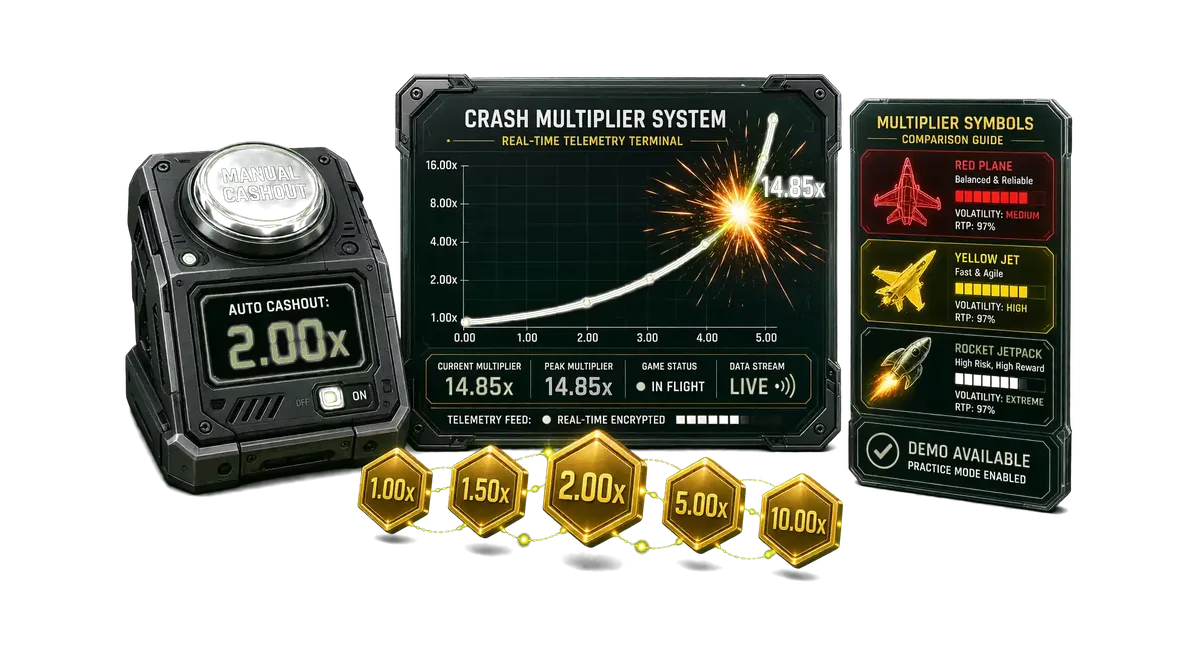
- Multiplier — the value a bet is scaled by if cashed out at that moment. A multiplier of x2 doubles the stake if cashed out there.
- Round — one full cycle from the betting window opening to the round ending. A new round begins again shortly after the previous one closes.
- Cashout — the action of locking in the current multiplier before the round ends.
- Crash point — the multiplier value at which a given round ends, visible only after it happens, never in advance.
Manual vs Auto Cashout: A General Explanation
Manual cashout means tapping a cashout control at the moment a player chooses to lock in the current multiplier. It requires watching the round live and reacting before it ends, which gives full control over timing but depends on attention.
Some interfaces also offer an auto-cashout option, where a target multiplier is set in advance and the cashout triggers automatically if the round reaches it. Whether this is available, and exactly how it’s presented, depends on the current interface of a given game — it isn’t something to assume is present on every crash title here, and it’s worth checking directly inside each game. Setting an auto-cashout target does not change how likely a round is to reach that value; it only automates the timing of the action itself.
Risk and Variance in Crash Games
Each round in a crash game runs independently of the ones before and after it. A stretch of rounds ending early does not make a later round more likely to run longer, and these games do not follow a pattern that can be tracked from past outcomes. Round history shown in-interface is informational only.
Risk in this format comes down largely to bet size and cashout timing. Cashing out early locks in a smaller multiplier with more certainty. Waiting longer risks the round ending before a cashout lands, in exchange for a potentially larger multiplier if it does not. Published figures such as RTP percentages or multiplier caps, where cited publicly, are commonly quoted rather than fixed guarantees — the reliable habit is checking a game’s own info panel for current values.
Comparing the Three Crash Titles
The table below lines up what is confirmed for each of the three crash-style titles on this site. It compares mechanics and confirmed features only, not payout ranking.
| Game | Provider | Cashout Type | RTP / Multiplier Cap | Demo Mode |
|---|---|---|---|---|
| Aviator | Spribe | Manual; auto-cashout availability is interface-dependent | Commonly published near 97% RTP and a cap near x100 — not a fixed guarantee, confirm in-game | Confirmed |
| JetX | Smartsoft | Manual | Not confirmed — check in-game info panel | Confirmed |
| Lucky Jet | 1win Games | Manual; auto-cashout availability is interface-dependent | Not confirmed — check in-game info panel | Confirmed |
These three titles are not identical beneath the surface. They differ on provider, on which have a confirmed demo mode, and on which currently expose an auto-cashout control. Avia Masters sits outside this table entirely: it’s a confirmed BGaming title with 97% RTP, Low volatility and a x250 max multiplier, built around a plane-trajectory mechanic rather than a manual cash-out decision, so it’s covered on its own dedicated page instead of alongside these three.
Choosing Between the Three Titles
There is no confirmed basis here for ranking these three titles by payout, since published figures vary by source and aren’t independently verified for every title. A more practical way to approach the category is by pace and visual style: Aviator and JetX are widely recognized plane-themed titles from established third-party studios, while Lucky Jet runs on 1win’s own in-house build with a jetpack-character visual. Trying each in its confirmed demo mode, where available, is a reasonable way to get familiar with the interface before committing real funds. The game comparison hub lines up all eight games on this site side by side, including Plinko, Mines and Avia Masters.
FAQ
What makes a game a crash game specifically?
A round structure where a multiplier rises continuously from the start and a player decides when to cash out before the round ends. Aviator, JetX and Lucky Jet all use this format on 1win.
Are Plinko and Mines crash games?
No. Plinko settles in a single ball drop with no rising multiplier, while Mines proceeds one tile reveal at a time, entirely at the player’s own pace. Neither uses the continuous-round structure that defines a crash game.
Is Avia Masters a crash game?
Not in the classic sense used on this page. Avia Masters is a confirmed BGaming title where a plane moves along a set trajectory and the round resolves by reaching a destination or going down, rather than a single manual cash-out decision. It has its own dedicated page rather than sitting in this comparison.
Does auto-cashout make winning more likely?
No. Where available, it only automates the timing of a cashout at a preset multiplier. It does not change how likely a round is to reach that multiplier.
Do all three crash games work exactly the same way?
No. They share the same general rising-multiplier structure, but differ on provider, on confirmed demo availability, and on whether an auto-cashout control is currently exposed in the interface. Each game’s own page covers its specific details.
1win operates under a Curaçao gaming license, separate from any Indonesian regulatory approval. 18+.